US Unemployment Claims data expectations and impact on Dollar
 Aug 07th, 2026
 5 mins


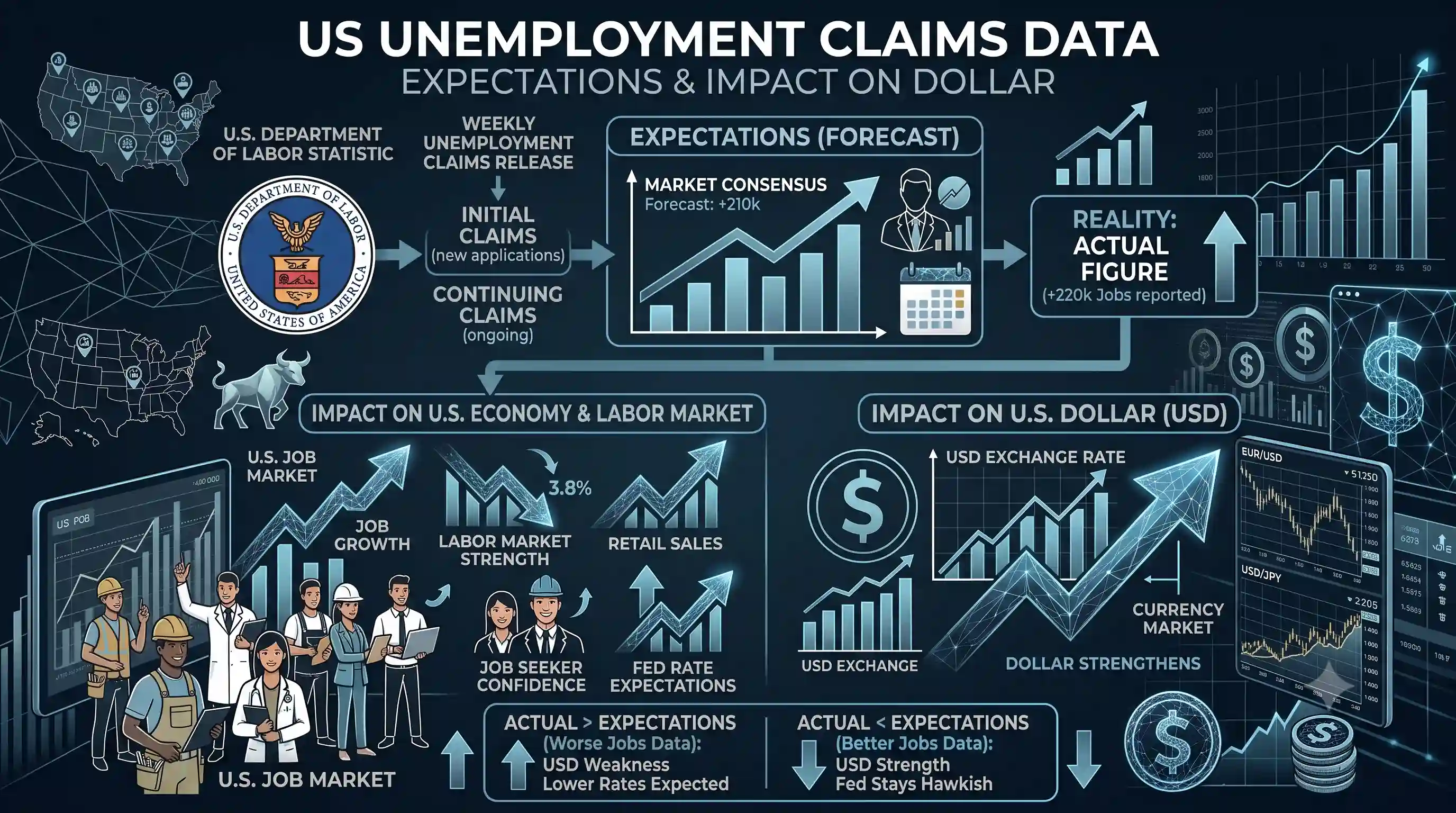
The U.S. Department of Labor is set to release its weekly report on Initial Jobless Claims today. Federal Reserve’s late-July hawkish hold on interest rates where central bankers kept borrowing costs elevated while absorbing a rare three-way vote dissent this high-frequency indicator provides financial markets with a real-time pulse on the stability of the American workforce.
As the labor market serves as the primary engine for consumer spending and Federal Reserve monetary policy, institutional foreign exchange desks and fixed-income allocators rely heavily on this weekly release. Today's figures will help clarify whether the U.S. labor market is maintaining its remarkable structural resilience or beginning to show subtle signs of cooling under prolonged financial tightening.
What Are We Expecting Today and Why?
Wall Street consensus estimates point toward a modest, controlled uptick in weekly filings, keeping first-time claims well within historical ranges that signal labor market stability:
● Initial Jobless Claims Forecast: Expected to print near 203,000 for the week ending August 1, up slightly from the prior week’s 197,000.
● Continuing Claims Forecast: Projected at 1.790 million for the week ending July 25, reflecting steady re-employment rates for displaced workers.
● 4-Week Moving Average: Expected to hover near 202,000 to 203,000, smoothing out short-term weekly volatility.
Key Factors Behind Today's Baseline:
1. Low Layoff Velocity: Business surveys consistently show that despite high borrowing costs and moderating corporate revenue growth, U.S. employers remain reluctant to trim headcount. Having navigated post-pandemic hiring shortages, firms are choosing to retain skilled workers rather than execute widespread layoffs.
2. Summer Seasonal Adjustments: Early-August jobless claims data frequently incorporates minor technical noise. Auto manufacturers and industrial facilities typically conduct summer tooling turnarounds during this period, accounting for the anticipated modest increase from 197,000 to 203,000.
Relevance for the US Labor Market
To evaluate the significance of today's release, it is essential to look at the broader structural trends shaping the U.S. employment landscape through mid-2026:
1. Shift from "Labor Shortage" to "Labor Hoarding"
Over the past two years, the U.S. labor market has transitioned from an era of acute labor shortages toward an environment characterized by lower turnover. While job openings (JOLTS) have gradually moderated from post-pandemic highs and hiring rates have normalized, layoff rates remain near historic lows. Maintaining initial claims near or below the 200,000–210,000 threshold confirms that structural labor demand remains intact.
2. Fed's Dual Mandate Alignment
Under Federal Reserve Chair Kevin Warsh, central bankers are closely monitoring employment metrics alongside persistent inflation risks. A stable labor market gives the Federal Reserve flexibility to keep interest rates in restrictive territory (currently 3.50%–3.75%) without causing immediate disruption to aggregate employment. Conversely, if claims were to break significantly higher, it would signal that restrictive interest rates are beginning to erode labor market health, shifting central bank focus toward supporting growth.
Scenario Analysis for the U.S. Dollar
Scenario A: Strong Upside Labor Beat (Claims print below 192,000)
● Macro Context: An unexpectedly low claims figure confirms that corporate layoff activity is practically non-existent and labor demand remains exceptionally firm. This reinforces the Fed's hawkish hold narrative and strengthens market expectations for another 25-basis-point interest rate hike as early as the September FOMC meeting.
● Dollar Impact: U.S. Dollar rallies strongly across major pairs.
○ USD/JPY: Advances cleanly as rising U.S. Treasury yields widen the interest rate advantage over the Bank of Japan.
○ GBP/USD & EUR/USD: Come under selling pressure as capital rotates into higher-yielding greenback assets.
○ XAU/USD (Gold): Pulls back as rising real bond yields elevate the opportunity cost of holding non-yielding physical bullion.
Scenario B: Neutral Consensus Base (Claims print between 198,000 and 208,000)
● Macro Context: The official release aligns closely with the expected 203,000 figure. It confirms an orderly, stable labor environment without signaling extreme tightness or sudden softening.
● Dollar Impact: U.S. Dollar remains range-bound within recent technical consolidation zones. Foreign exchange desks will digest the data smoothly, turning their focus toward upcoming inflation metrics and macroeconomic releases.
Scenario C: Sharp Downside Miss (Claims spike above 220,000)
● Macro Context: A unexpected jump in weekly filings signals that corporate layoffs are picking up speed under the weight of prolonged borrowing costs. This raises immediate concerns over second-half economic growth and accelerates market bets on dovish Federal Reserve rate cuts.
● Dollar Impact: U.S. Dollar drops rapidly across the board.
○ USD/JPY: Plunges as falling U.S. Treasury yields trigger an unwinding of long-dollar carry positions.
○ GBP/USD & EUR/USD: Rally past key local technical resistance levels.
○ XAU/USD (Gold): Spikes higher, supported by falling bond yields and defensive safe-haven demand.
Today's initial jobless claims release serves as a crucial barometer of U.S. workforce health. For currency traders and macro allocators, the margin of divergence from the 203,000 consensus will determine whether the U.S. Dollar gains fresh upward momentum or experiences a temporary pullback heading into the second half of the week.