US Consumer confidence expectations and impact on dollar index
 Jun 30th, 2026
 5 mins


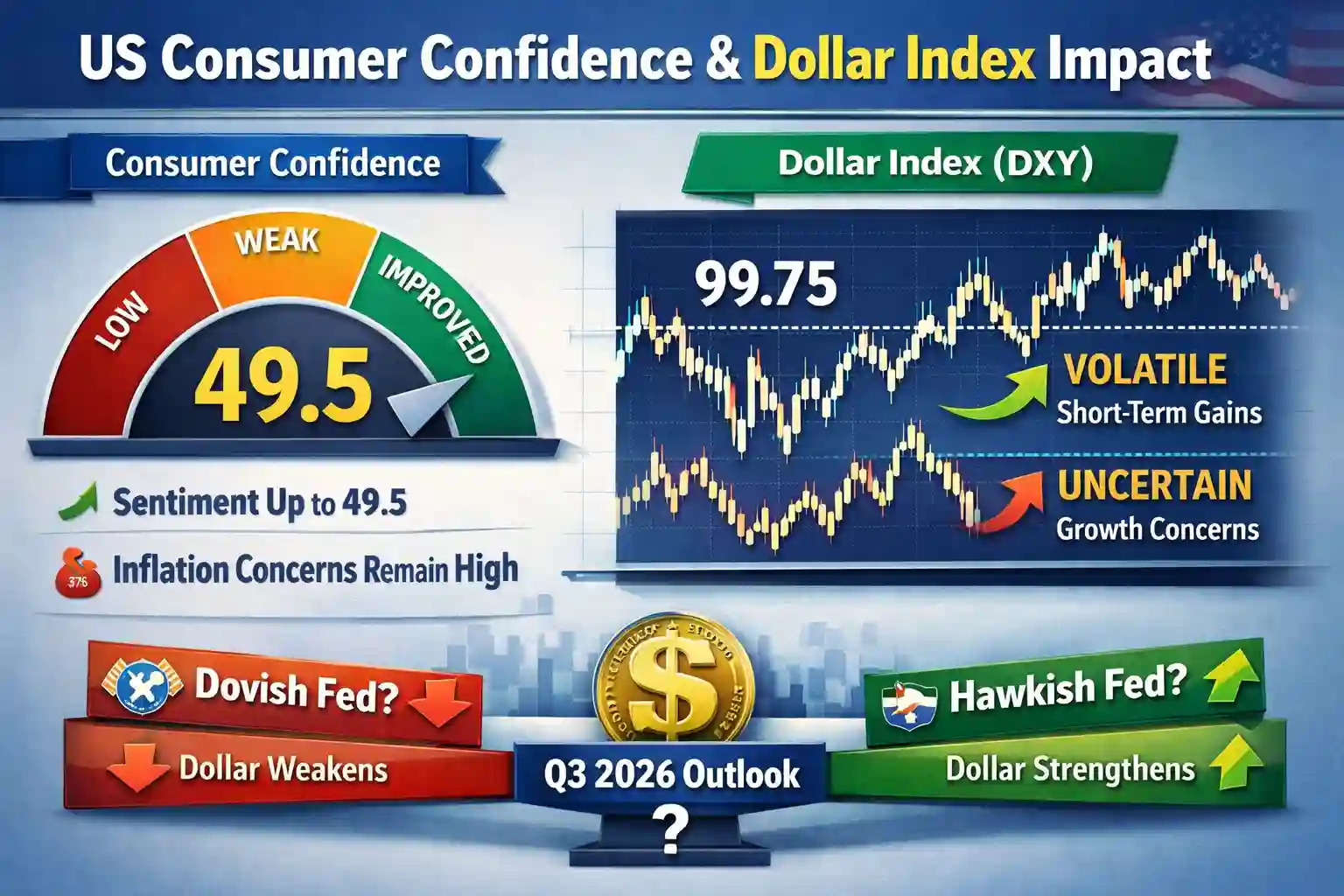
Today’s release of the monthly Consumer Confidence Index by The Conference Board arrives at a critical juncture for the United States economy. As a vital leading economic indicator, consumer confidence acts as a window into future household spending, the engine that drives roughly 70% of U.S. Gross Domestic Product (GDP). With markets on edge due to shifting central bank dynamics and recent geopolitical headlines, today’s data point will likely inject immediate, sharp volatility into global asset classes, particularly major U.S. Dollar currency pairs.
Understanding the Trend Line
To understand what is expected today, we have to look back at the trajectory of the first half of the year. Consumer sentiment took a severe hit in the spring, largely triggered by heightened geopolitical friction in the Middle East and a corresponding spike in energy costs. The University of Michigan's parallel sentiment gauge hit an all-time historical low in May, dropping to 44.8, while The Conference Board’s metric similarly registered growing consumer caution.
However, recent data suggests the baseline is beginning to stabilize. A moderate cooling in retail gasoline prices through the month of June has relieved an immediate psychological burden on the American household. Despite this modest relief, the cost of living remains the single most dominant factor occupying the consumer's mind. Over half of all surveyed households continue to spontaneously cite persistent high prices as a heavy anchor on their personal financial health.
What is Expected Today and Why?
Wall Street consensus points toward a slight, measured uptick in the headline Consumer Confidence number today compared to May's muted levels. Why a modest increase is expected: 1. Easing Short-Term Anxiety: The immediate, acute fear of localized conflicts spiraling into a broader macroeconomic disaster has begun to take a back seat. Consumers are showing an improved five-year outlook on business conditions.
2. "Low-Hire, Low-Fire" Labor Equilibrium: While tech and financial corporate spaces have seen cooling, the broader U.S. jobs market remains stable enough to prevent widespread panic regarding immediate structural unemployment. Why the upside remains capped: 1. Sticky Inflation Reality: Year-ahead inflation expectations are hovering near 4.6%. While this is down from the peak seen in May (4.8%), it remains significantly higher than the pre-escalation baseline of 3.4% seen early in the year. 2. Current Conditions vs. Expectations Divergence: Even as future expectations recover out of absolute survival territory, consumers' assessments of their present personal economic reality remain highly restricted, signaling a deep reluctance to engage in large-scale discretionary spending or durable goods purchases. U.S. Dollar Blueprint: Three Scenario Analyses The foreign exchange market will interpret today’s release through the lens of Federal Reserve monetary policy. Because the Fed is weighing sticky inflation against signs of broad economic cooling, today’s number provides a blueprint for how the U.S. Dollar (USD) will trade against major crosses such as USD/JPY and GBP/USD, as well as spot gold (XAU/USD). Scenario A: Strong Numbers (Index prints well above consensus)
● The Macro Context: A resilient consumer base implies that aggregate domestic demand is too warm to allow inflation to drop cleanly back to the Fed's target. This would force policy makers to maintain a restrictive, high-for-longer interest rate stance.
● Dollar Impact: The dollar gains immediate structural traction. Scenario B: Soft Uptick (Matches expectations)
● The Macro Context: This confirms the narrative of an economy that is bending but not breaking a slow normalization where high costs keep a lid on excessive expansion, but the consumer doesn't completely retreat.
● Dollar Impact: The Dollar remains range-bound, maintaining its current consolidation patterns. Volatility will be transient, with currency desks shifting their immediate focus back to upcoming labor and hard inflation data. Scenario C: Sharp Miss (Index plunges unexpectedly)
● Macro Context: A breakdown in consumer confidence implies that the cumulative weight of high interest rates and sticky core prices has broken household resilience. This raises the immediate threat of a sharper corporate slowdown and a faster drop in consumer spending.
● Dollar Impact: The U.S. Dollar experiences an immediate leg down on expectations that the Fed may be forced to accelerate monetary easing to defend the economy. Today’s release is more than just a confidence gauge; it is a vital indicator of whether the structural backbone of U.S. economic growth is keeping its footing or experiencing a deeper slowdown. For capital allocators across equities and forex, the degree of divergence from today's consensus will set the foundational tone for risk management heading into the new trading month.