Unemployment Claims expectations and impact on Dollar
 Jul 09th, 2026
 5 mins


Weekly Unemployment Insurance Claims report by the U.S. Department of Labor offers financial markets an important high-frequency look at the health of the American worker. Coming right after a soft monthly non-farm payrolls cycle that shifted expectations for the Federal Reserve's next policy move, institutional trading desks use this real-time data to gauge whether layoffs are picking up speed or remaining low.
Previous Trend
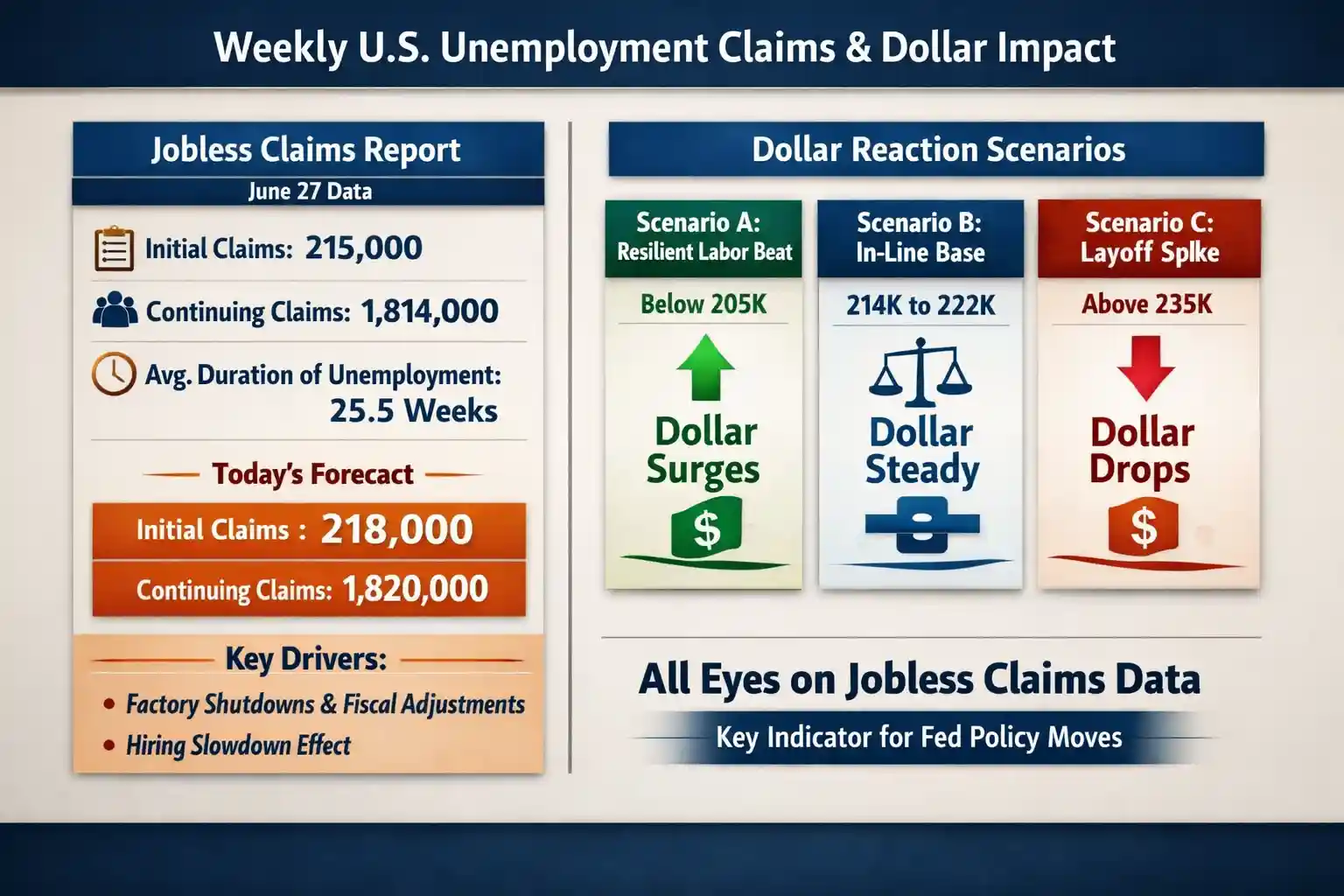
To understand what to look for today, we have to look at the trend line established over the past few weeks. Initial jobless claims have remained historically low, hovering within a stable range. In the previous week ending June 27, first-time filings ticked down slightly to 215,000, while the less volatile four-week moving average settled at 222,000.
● Stable Initial Layoffs: The low volume of weekly filings shows that widespread corporate layoffs are not a major threat to the current economic expansion. Companies are holding onto their existing staff.
● Rising Continuing Claims: In contrast, continuing claims—which measure the number of people already receiving benefits—have gradually increased, reaching 1.814 million.
● Extended Duration: Macroeconomic data shows the average duration of unemployment rose to 25.5 weeks in June compared to 21.5 weeks at the same time last year. This indicates that while companies aren't firing aggressively, workers who lose their jobs are taking noticeably longer to find new positions.
What Are We Expecting Today and Why?
Wall Street consensus forecasts point toward a minor, incremental increase for today's release:
● Initial Jobless Claims Forecast: Expected to print at 218,000, up slightly from the previous week's 215,000.
● Continuing Jobless Claims Forecast: Anticipated to move up to 1,820,000, continuing its slow upward trend. Drivers Behind Today's Estimate:
1. Mid-Summer Corporate Adjustments: Early July data often sees minor noise from short-term factory shutdowns and corporate fiscal-year alignment, which typically causes a small bump in baseline filings.
2. The Hiring Slowdown Effect: Because broader corporate hiring pipelines have slowed down, continuing claims are expected to remain elevated as individuals spend more time in between jobs.
Scenario Analysis for the U.S. Dollar
Scenario A: Resilient Labor Beat (Prints below 205K)
● Macro Context: A surprise drop in claims proves that labor demand remains very firm and layoffs are practically non-existent. This outcome dials back recent dovish policy expectations, suggesting the Fed can keep interest rates higher for longer to make sure inflation cools completely.
● Dollar Impact: Dollar strengthens quickly.
Scenario B: Neutral In-Line Base (Prints between 214K and 222K)
● Macro Context: A print near consensus confirms an orderly, controlled adjustment. It shows a labor market that is normalizing rather than cracking under high interest rates.
● Dollar Impact: U.S. Dollar remains range-bound within its recent consolidation zones. Currency desks will treat the data as temporary, quickly shifting focus to comments from Fed officials later in the session to find their next major trade setup.
Scenario C: Sudden Layoff Spike (Prints above 235K)
● The Macro Context: A sharp jump above recent averages would signal that corporate layoffs are accelerating under prolonged restrictive financial conditions. This raises immediate warning flags about a broader economic slowdown and consumer spending risks.
● Dollar Impact: Dollar drops rapidly as markets price in faster, front-loaded interest rate cuts from the Federal Reserve. Today's jobless claims data offers an important, real-time look into corporate workforce decisions. For macro allocators and forex desks, the margin of divergence from the 218K estimate will define the immediate risk boundaries and intraday trading direction heading into the weekend.