Non Farm Payroll expectations and its impact on Labor market and Dollar
 Aug 07th, 2026
 5 mins


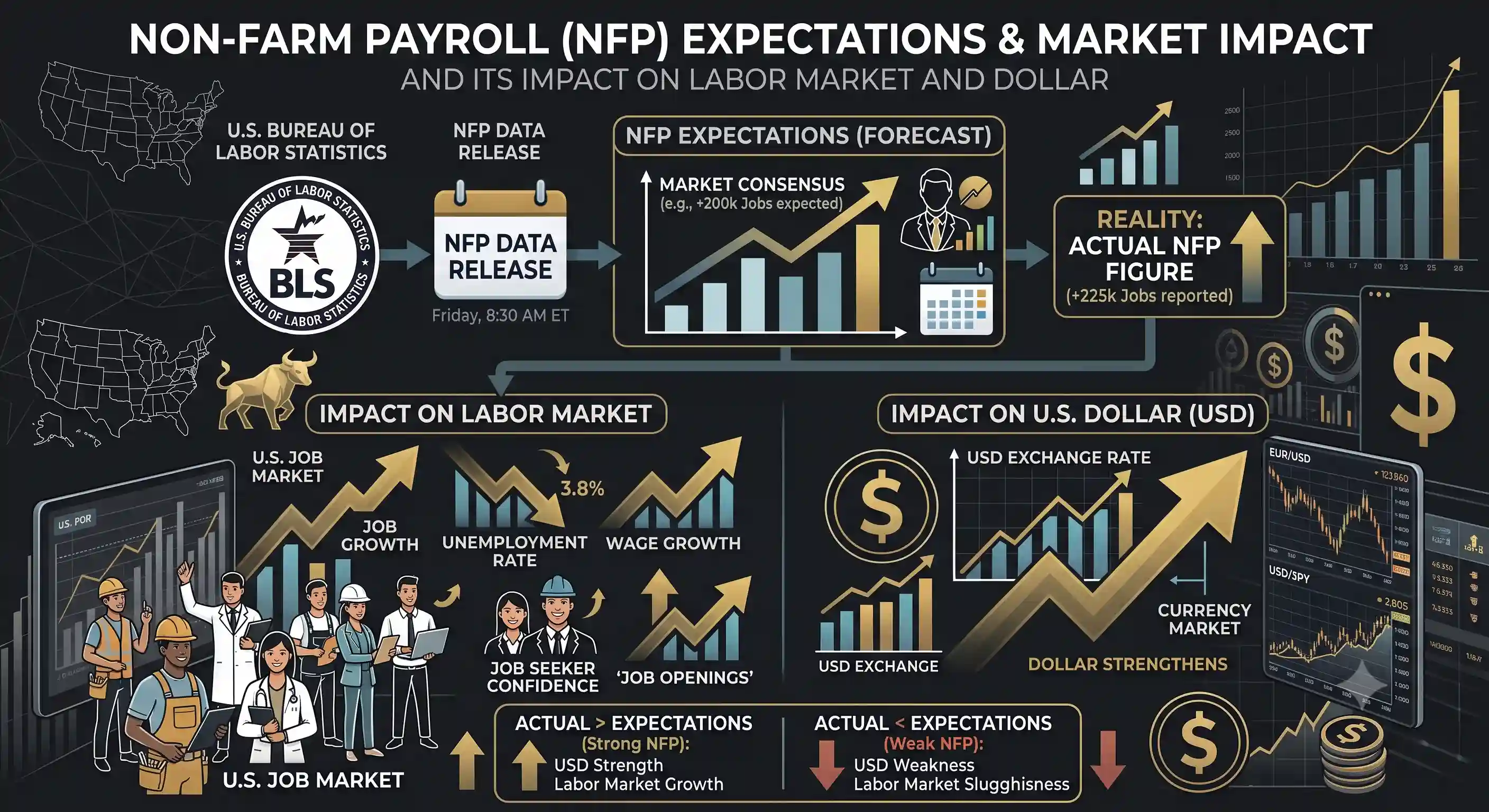
The U.S. Bureau of Labor Statistics (BLS) is scheduled to publish its employment situation report for July 2026. Coming just over a week after the Federal Reserve delivered a hawkish hold on interest rates keeping the benchmark federal funds rate at 3.50%–3.75% amidst a rare three-way vote dissent favoring immediate tightening today’s Non-Farm Payroll (NFP) print serves as the ultimate benchmark for U.S. economic health.
As central bankers evaluate whether inflation risks require additional monetary tightening or if high borrowing costs are adequately cooling aggregate demand, financial markets across foreign exchange, fixed income, and equities will tune into today's labor figures for directional guidance.
What are We Expecting Today and Why?
Wall Street consensus estimates point toward a modest rebound in net job creation for July following June’s softer reading:
● Non-Farm Payrolls Forecast: Expected to print between 80,000 and 97,500 net new jobs, recovering from June's modest 57,000 gain.
● Unemployment Rate Forecast: Projected to remain steady at 4.2%, matching June's reading.
● Average Hourly Earnings Forecast: Expected to grow by 0.3% month-on-month and 3.5% year-on-year, indicating that wage-push inflation pressures remain generally moderate.
● Labor Force Participation Rate: Expected to hold near 61.5%.
Key Drivers and Leading Indicators Behind Today's Estimate:
1. Divergent Leading Surveys: Sub-indicators heading into today's report deliver a nuanced backdrop. The ADP private payrolls report logged a modest gain of 44,000 jobs, and the ISM Services Employment Index dipped into contraction territory at 47.4. However, manufacturing employment metrics improved to 52.8, and weekly initial jobless claims remained historically low near 197,000 to 203,000.
2. Seasonal and Benchmark Revisions: Investors will closely examine revisions to prior months. In June, joint negative revisions subtracted 74,000 jobs from April and May estimates. A similar downward adjustment today could temper the impact of any headline beat.
Relevance for the Labor Market
To understand today's stakes, it is helpful to place the July employment report within the broader structural evolution of the U.S. labor landscape over mid-2026:
1. Labor Hoarding
The U.S. workforce has effectively transitioned into a low-hire, low-fire regime. While corporate job openings (JOLTS) have gradually moderated from peak levels and net hiring velocity has slowed, business owners remain hesitant to reduce workforce headcount. Having navigated past hiring bottlenecks, firms are opting for labor hoarding keeping headcount stable while trimming overall overtime hours and slowing new recruitment.
2. The Fed's Dual-Mandate Calculus
With consumer price index measures hovering around 3.5%, Federal Reserve policymakers under Chair Kevin Warsh are balancing persistent price stability concerns against labor market health. If today's job creation holds within the 80,000 to 100,000 range alongside steady 4.2% unemployment, it confirms that the labor market is normalizing in an orderly manner. This soft landing environment gives central bankers the flexibility to maintain
restrictive interest rates without causing immediate widespread labor market distress.
Multi-Scenario Analysis for the U.S. Dollar
Scenario A: Strong Upside Beat (NFP prints above 130,000;
Unemployment drops to 4.1%)
● Context: An unexpectedly robust jobs print proves that hiring momentum is re-accelerating, completely looking past June's soft reading. Combined with firm wage growth, this scenario reignites worries over secondary inflation, significantly raising market expectations for a Federal Reserve rate hike at the September
meeting.
● Dollar Impact: U.S. Dollar rallies aggressively across the board.
○ USD/JPY: Spikes as rising U.S. Treasury yields widen the interest rate advantage over the Bank of Japan.
○ EUR/USD & GBP/USD: Slide under selling pressure as capital rotates toward higher-yielding assets.
○ XAU/USD (Gold): Pulls back sharply toward support levels as higher real yields increase the opportunity cost of holding non-yielding physical bullion.
Scenario B: Neutral Goldilocks Baseline (NFP prints between 75,000 and
100,000; Unemployment at 4.2%)● Context: The official release aligns with consensus expectations. It confirms that while labor market expansion has slowed from earlier years, the U.S. economy is neither entering a sharp recession nor re-igniting demand-pull inflation.
● Dollar Impact: U.S. Dollar remains relatively range-bound. Foreign exchange desks digest the headline figures smoothly, shifting focus to wage growth nuances and broader macroeconomic headlines.
Scenario C: Sharp Downside Miss (NFP prints below 40,000;
Unemployment rises to 4.4%+)
● Macro Context: A sharp contraction in net job creation—accompanied by heavy downward revisions to prior figures—signals that prolonged interest rate pressure is beginning to weigh on employment. This sparks immediate recession concerns and prompts markets to price out future rate hikes while pulling forward bets on dovish monetary easing.
● Dollar Impact: U.S. Dollar experiences a broad-based decline.
○ USD/JPY: Plunges as falling Treasury yields force an unwinding of long-dollar carry positions.
○ EUR/USD & GBP/USD: Rally past key technical resistance levels.
○ XAU/USD (Gold): Surges on a bullish run, supported by lower bond yields and defensive safe-haven allocation.
Today's July Non-Farm Payrolls report is the primary macro catalyst of the trading week. Whether job growth validates the 80,000 consensus or delivers an unexpected shock will establish the underlying trajectory for the U.S. Dollar and global financial markets heading into the second half of August.