NFPR Expections and impact on Dollar and Forex pairs
 Jul 02nd, 2026
 5 mins


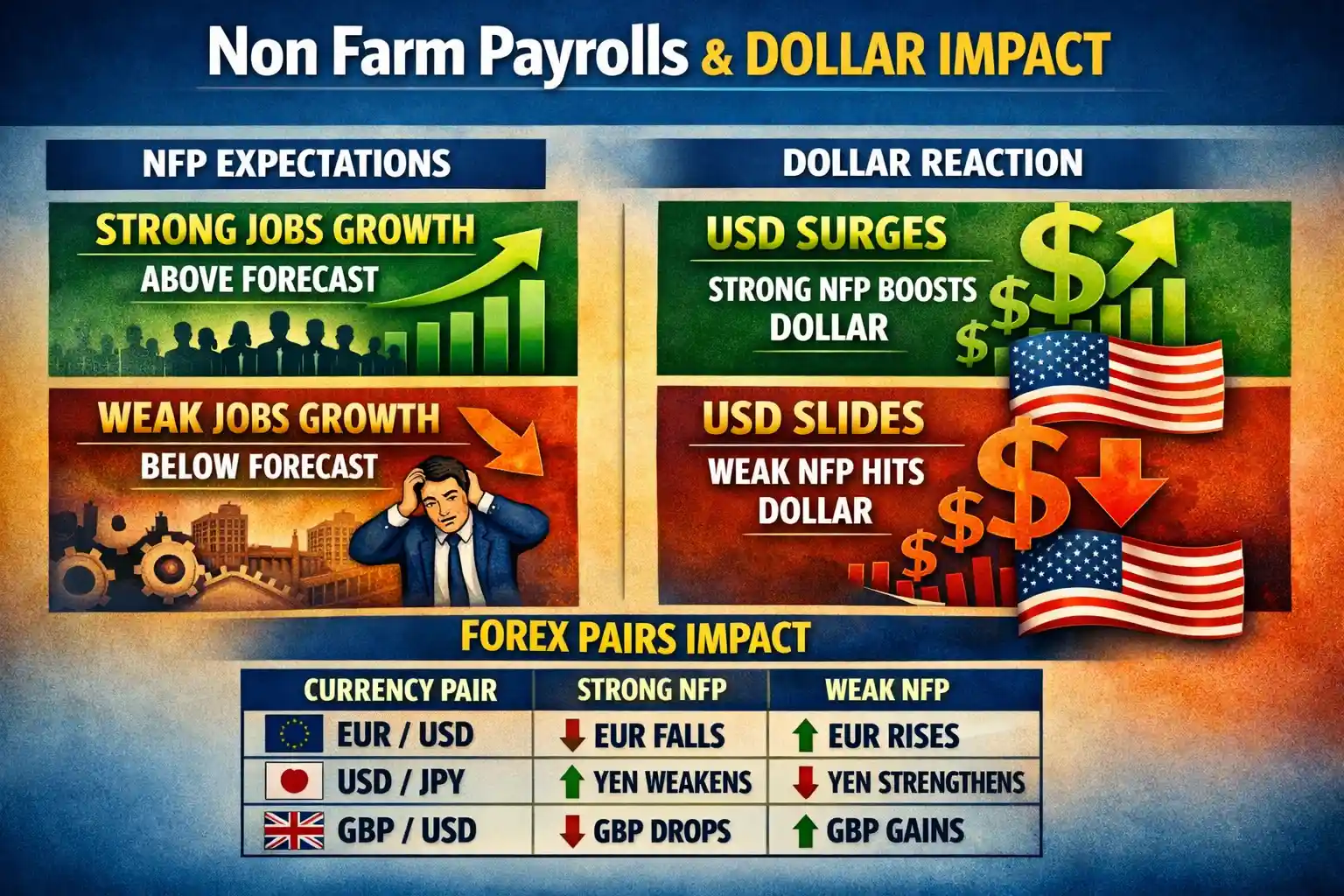
Today’s release of the U.S. Non-Farm Payrolls (NFP) report by the Bureau of Labor Statistics (BLS) stands as the critical event for global financial markets this week. Because it provides the most comprehensive evaluation of job creation, wage inflation, and overall labor supply, institutional trading desks view this report as the ultimate compass for Federal Reserve interest rate policy.
With a hawkish Federal Reserve keeping a close eye on structural inflation risks, today's employment numbers will directly dictate the next major structural leg for the U.S. Dollar (USD), sending sharp waves of volatility across major currency pairs like USD/JPY, GBP/USD, and spot gold (XAU/USD).
Previous Trend
To understand today's stakes, we have to look at the momentum coming out of late spring. May’s official payroll report delivered a massive upside surprise, showing an expansion of 172,000 new positions. This print handily beat consensus estimates and proved that despite high borrowing costs, a solid baseline of job creation remained intact.
Historically, several underlying factors have defined this labor landscape:
● Low-Hire, Low-Fire Equilibrium: Layoffs have remained highly localized (predominantly within tech and administrative back-offices), while broader industrial, transport, and leisure firms have held tightly onto their existing workers.
● Sticky Wage Pressures: Average Hourly Earnings grew by 0.3% month-over-month in May, pushing the annual rate to 3.4%. This persistent wage growth has kept consumer aggregate demand well-insulated, making the Fed cautious about cutting rates too quickly.
● ising Unemployment Base: Despite solid job numbers, the unemployment rate ticked up to 4.3% in May, reflecting a steady expansion of the labor supply via rising immigration and participation, rather than an aggressive wave of corporate downsizing.
What is Expected Today and Why?
The institutional Wall Street consensus forecast expects today's headline June payroll expansion to print between 110,000 and 114,000 new jobs. This represents a clear moderation from May's blazing 172,000 expansion.
Why a softer, moderated print is expected today:
1. Leading Indicator Validation: The ADP Private Payrolls report released earlier this week registered a soft 98,000 gain for June, indicating that purely private corporate hiring is beginning to pace backward toward long-term baseline averages.
2. Exhaustion of Post-Pandemic Catch-up: The hyper-accelerated hiring patterns in the leisure, food service, and hospitality sectors have largely run their course, transitioning back into normal seasonal adjustments.
3. Sticky Internal Targets: The Unemployment Rate is projected to hold steady at 4.3%, while annual Average Hourly Earnings are expected to edge slightly higher to 3.5% year-over-year.
Scenario Analysis for the U.S. Dollar
The foreign exchange market treats the NFP print as a direct proxy for future interest rate yield. The deviation from the 110K–114K consensus range will trigger immediate realignments across major asset classes.
Scenario A: Hawkish Acceleration Beat (Prints above 150,000)
● Macro Context: An upside surprise completely shatters the cooling narrative. It signals that the domestic economic engine is running too hot, giving the Fed ample reason to delay monetary easing or potentially discuss further rate hikes to stamp out wage inflation.
● Dollar Impact: The Dollar goes on a massive broad-based rally.
○ USD/JPY: Expected to break violently higher, capitalising on widened U.S. yield premiums while stretching intervention zones around 162.60.
○ GBP/USD: Drops heavily to 1.3160 as capital moves away from the British Pound to lock in higher U.S. fixed-income yields.
○ XAU/USD (Gold): Faces a rapid, severe selloff to $3930 as rising real yields dramatically increase the opportunity cost of holding non-yielding physical bullion.
Scenario B: Stabilization (Prints between 105,000 and 125,000)
● Macro Context: An in-line print confirms the soft landing ideal. It demonstrates that the labor market is cooling down in a controlled fashion slow enough to dampen inflation expectations, but firm enough to prevent a sudden consumer spending cliff.
● Dollar Impact: The U.S. Dollar consolidates within its existing ranges. Because this scenario matches current institutional pricing models, initial spikes will quicky give way to range-bound mean reversion, leaving the market to wait for the next inflation data release for structural direction.
Scenario C: Growth Shock Miss (Prints below 85,000)
● Macro Context: A significant miss below the 90k threshold would signal that restrictive monetary policy has finally broken through corporate defenses. This outcome alerts the market that a sharper economic deceleration might be underway, forcing an aggressive shift in Fed policy expectations.
● Dollar Impact: The U.S. Dollar collapses across the board as interest rate markets aggressively price in rapid, front-loaded interest rate cuts.
○ USD/JPY: Declines sharply to test 160 and suddenly as carry-trade capital unwinds, triggering severe downward pressure on the pair.
○ GBP/USD: Rallies decisively as the U.S. yield advantage vanishes.
○ XAU/USD (Gold): Spikes into an aggressive bullish run to $4230, fueled by dropping Treasury yields and a strong rush into non-sovereign safe havens.
Today's NFP report is a defining risk event for the global macro landscape. By offering a clear look at how corporate employment budgets are reacting to high interest rates, the margin of divergence from the 110K–114K forecast will define market direction, trend lines, and risk boundaries for weeks to come.