Major miss in NFP and how market reacted
 Jul 03rd, 2026
 5 mins


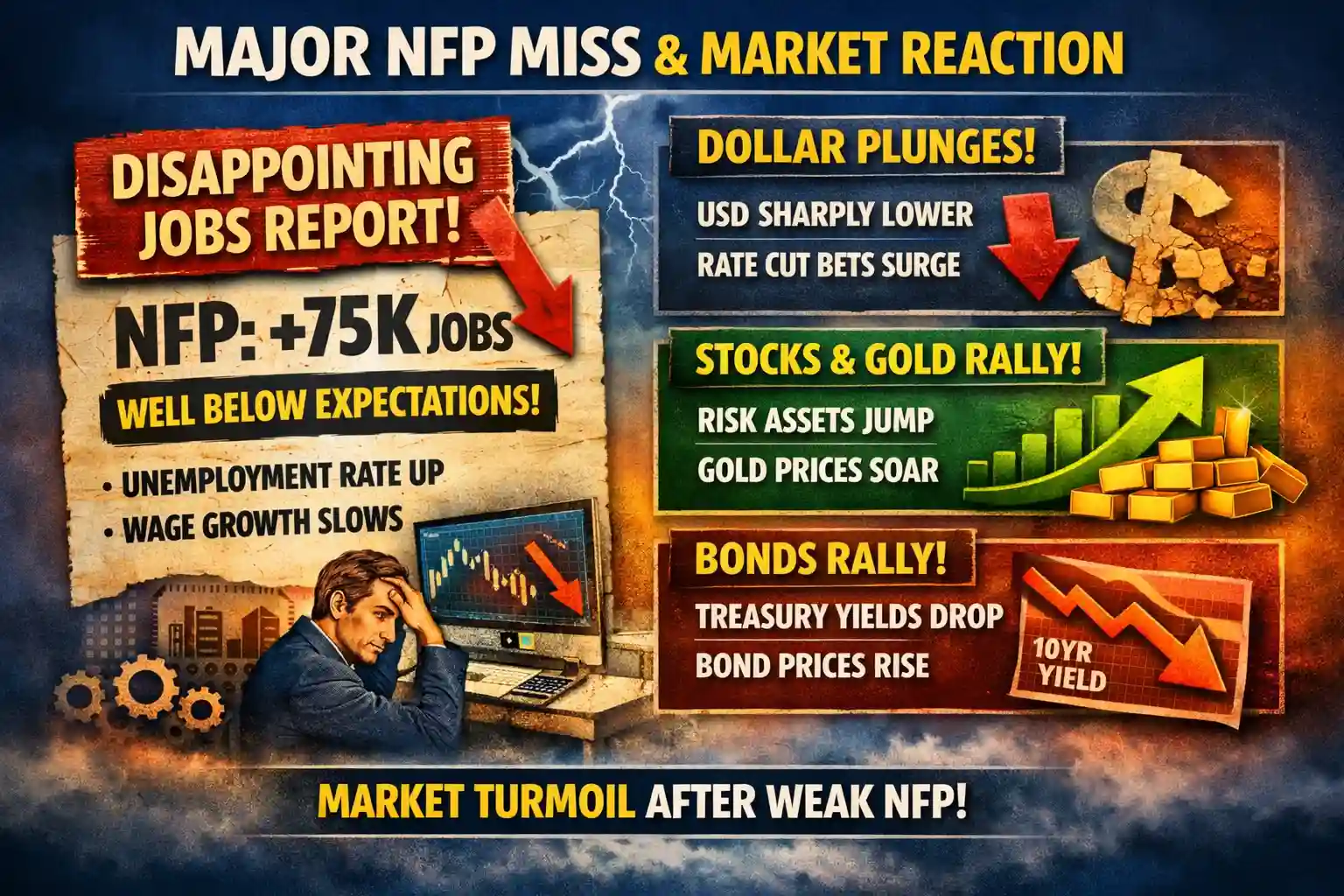
The highly anticipated U.S. Non-Farm Payrolls (NFP) report released by the Bureau of Labor Statistics (BLS) delivered a major curveball to global financial markets. Emerging from a period where the Federal Reserve maintained a hawkish stance to combat inflation, the fresh data reveals a sharp downshift in the corporate hiring engine. Instead of reinforcing the narrative of an overheated domestic economy, the print indicates that restrictive monetary policies are fundamentally cooling the American labor market.
Core Data: A Substantial Miss
The headline payroll expansion for June printed at a modest 57,000 new positions. This figure represents a major deceleration from previous periods and fell drastically short of institutional consensus forecasts, which had anticipated a controlled stabilization around 110,000 to 115,000 jobs.
Further cementing the downshift, the BLS implemented substantial downward revisions to the preceding months.May’s strong payroll addition was revised down from 172,000 to 129,000, while April's figures were clipped from 179,000 to 148,000—representing a combined loss of 74,000 jobs from prior estimates.
Paradoxically, the headline unemployment rate ticked down slightly from 4.3% to 4.2%. Rather than reflecting a surge in corporate hiring, this minor drop was driven by supply-side dynamics: roughly 720,000 individuals exited the active labor force, shrinking the participation pool. Meanwhile, wage inflation remained stable, with Average Hourly Earnings rising by 0.3% over the month, holding the annual rate at 3.5%.
Sector Dynamics: What Drove the Slowdown?
The composition of the establishment survey highlights a stark divergence across domestic industries:
● Slower Drivers: Professional and business services (+36,000) along with healthcare (+22,000) continued to serve as the baseline pillars of employment expansion. However, the pace in healthcare marks a visible deceleration from its rolling 12-month average of 38,000.
● Leisure Deficit: The primary drag on the June print came from the leisure and hospitality sector, which unexpectedly shed 61,000 positions. Analysts note that weaker-than-usual seasonal hiring patterns heavily muted this sector, failing to get the typical summer lift.
● "Low-Hire, Low-Fire": Industrial sectors including manufacturing, construction, mining, financial activities, and government employment remained entirely flat, demonstrating an economic landscape where companies are protecting their existing margins rather than expanding team sizes.
Macro Relevance
This sudden deceleration alters the policy backdrop for Federal Reserve Chairman Kevin Warsh and the Federal Open Market Committee (FOMC). Prior to this release, hot economic signals and elevated headline CPI metrics (which crossed 4% due to Middle East energy strains) had biased the central bank toward a prolonged hold or even further tightening.
The 57,000 print provides clear evidence that high borrowing costs are achieving their cooling intent. Consequently, implied interest rate futures shifted rapidly following the release. According to the CME FedWatch Tool, the probability of a near-term rate hike at the late-July FOMC meeting dropped from 29% down to 18%, while expectations for a September hike eased noticeably to 54%. The data shifts market conversations away from further tightening and firmly back toward when the first policy cut will materialize.
How U.S. Dollar Reacted
Immediate Market Response
Because the print fell short of expectations, it eliminated the immediate threat of a hawkish Fed hike. The U.S. Dollar Index (DXY) faced immediate downward pressure as Treasury yields slid.
● USD/JPY: The pair fell sharply from its recent highs to test 160.60. With the yield premium on U.S. fixed-income assets compressing, global capital began unwinding crowded dollar-long positions, easing pressure on the yen.
● GBP/USD: The British Pound capitalized on the dollar's broad retreat, rallying toward 1.34.
● XAU/USD (Gold): Spot gold prices caught a decisive bullish bid $4143 yesterday and $4195 today. Plummeting real yields and the reduced likelihood of higher interest rates boosted the appeal of non-yielding physical bullion.
Moving into the second half of the year, the structural direction of the dollar will depend on whether this soft print is a temporary anomaly or a deeper trend. If upcoming mid-month Consumer Price Index (CPI) numbers mirror this cooling trend by printing lower, the U.S. Dollar is likely to sustain a broader multi-week deprecation as markets fully price in a dovish Fed pivot. Conversely, if inflation indicators remain stubborn despite the soft jobs print, the greenback will likely enter a highly volatile, range-bound consolidation phase as market participants weigh slowing growth against sticky consumer prices.