ISM Manufacturing PMI expectations and impact on dollar
 Jul 01st, 2026
 5 mins


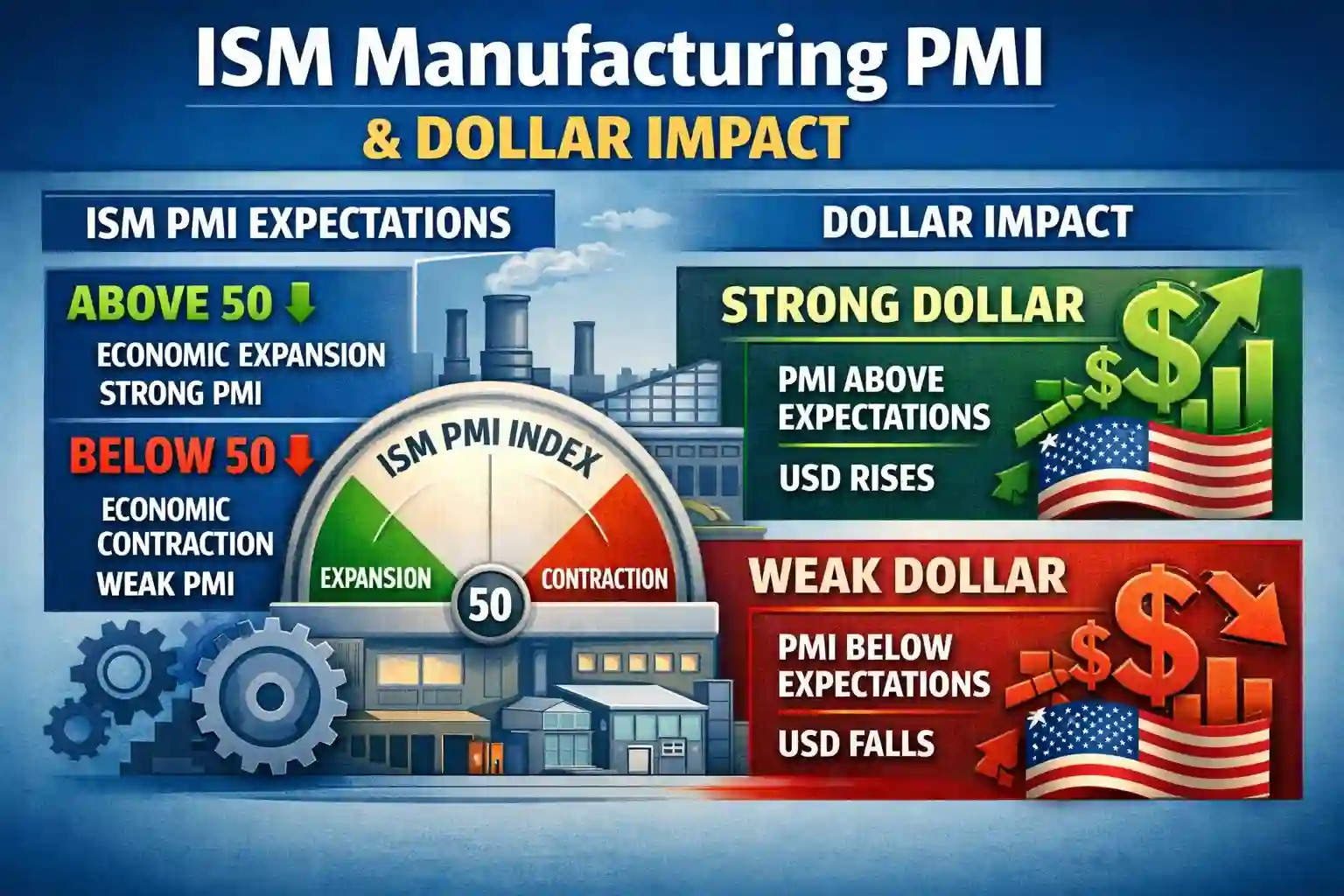
Today’s release of the Institute for Supply Management (ISM) Manufacturing Purchasing Managers’ Index (PMI) will provide critical insight into the health of the United States industrial backbone. Coming at a time when central bank policymakers are looking closely for signs of corporate resilience amid sticky input costs, this leading economic indicator carries substantial weight across global financial markets. Because the index serves as a real-time health check on corporate spending, order backlogs, and hiring, today’s figure will directly influence near-term expectations for Federal Reserve monetary policy, triggering a direct chain reaction through the value of the U.S. Dollar.
Broader Trend
To interpret today’s expectations, we have to look at the trend line established over the first half of the year. U.S. manufacturing has successfully carved out a sustained path of growth. May’s headline ISM reading registered at 54.0, marking five consecutive months of net expansion (readings above the 50.0 threshold) and matching the sector's strongest performance since May 2022. Driving this momentum has been a powerful resurgence in domestic demand:
● Demand Engine: The New Orders sub-index accelerated cleanly to 56.8 in May, proving that businesses are engaging in more than bare-minimum inventory maintenance.
● Cost Caveat: This growth has come at a massive premium. The ISM Prices Paid Index hit an elevated 82.1 in May, reflecting intense price volatility driven by tariff anxieties, supply chain adjustments, and earlier energy price shocks.
● Hiring Lag: Even though factory floors are spinning out goods, the Employment sub-index has remained structurally mired in contraction territory (48.6), indicating a corporate strategy focused strictly on maximizing productivity through existing staff over new hiring.
What is Expected Today and Why?
The Wall Street consensus forecast expects today's ISM headline figure to print at 53.8, a microscopic, marginal cooling from May’s 54.0 milestone.
Why a steady, expansionary print is expected:
1. Parallel Data Validation: The S&P Global US Manufacturing PMI for June accelerated to a multi-year high of 55.7. This strongly implies that the foundational underlying industrial activity specifically raw production volumes and backlogs remains robustly anchored in positive territory.
2. Depleted Customer Inventories: Corporate client inventory levels have shrunk to a point where manufacturers must maintain steady operations simply to satisfy baseline fulfillment needs, providing a natural floor under production numbers. Scenario Analysis for the U.S. Dollar Scenario A: Growth Acceleration Beat (Index prints at 54.5 or higher)
● Macro Context: An upside surprise indicates the industrial engine is gaining speed, not cooling down. A booming manufacturing sector paired with hot input costs sends a clear warning to the Fed that aggregate demand is too strong to risk cutting interest rates early.
● Dollar Impact: Dollar goes on an immediate bullish. Scenario B: Baseline Consolidation (Index prints near consensus, 53.6 – 54.0)
● Macro Context: This confirms a goldilocks economic scenario for the factory floor: steady, sustainable expansion that isn't overheating. It validates current pricing models without changing the broader economic trajectory.
● Dollar Impact: The Dollar remains within its recent consolidation ranges. Direct currency action will be short-lived, with institutional desks turning their full focus toward incoming labor data later in the week to find their next directional catalyst. Scenario C: Sharp Contractionary Miss (Index prints below 52.5)
● Macro Context: A deep miss signals that high borrowing costs and sticky input inflation have finally caused new orders to evaporate, exposing structural weakness in the domestic corporate pipeline.
● Dollar Impact: U.S. Dollar drops across the board as the market rapidly prices in an accelerated timeline for Fed monetary easing to shore up the economy.
Today's ISM release offers a transparent assessment of whether corporate America is keeping its footing or bowing under the pressure of prolonged restrictive financial conditions. For global macro traders, the margin of divergence from today's data will establish the operational risk boundaries for the entire trading month ahead.