Fog of Friction in US-Iran issue and ambiguity in Crude oil prices.
 Aug 04th, 2026
 5 mins


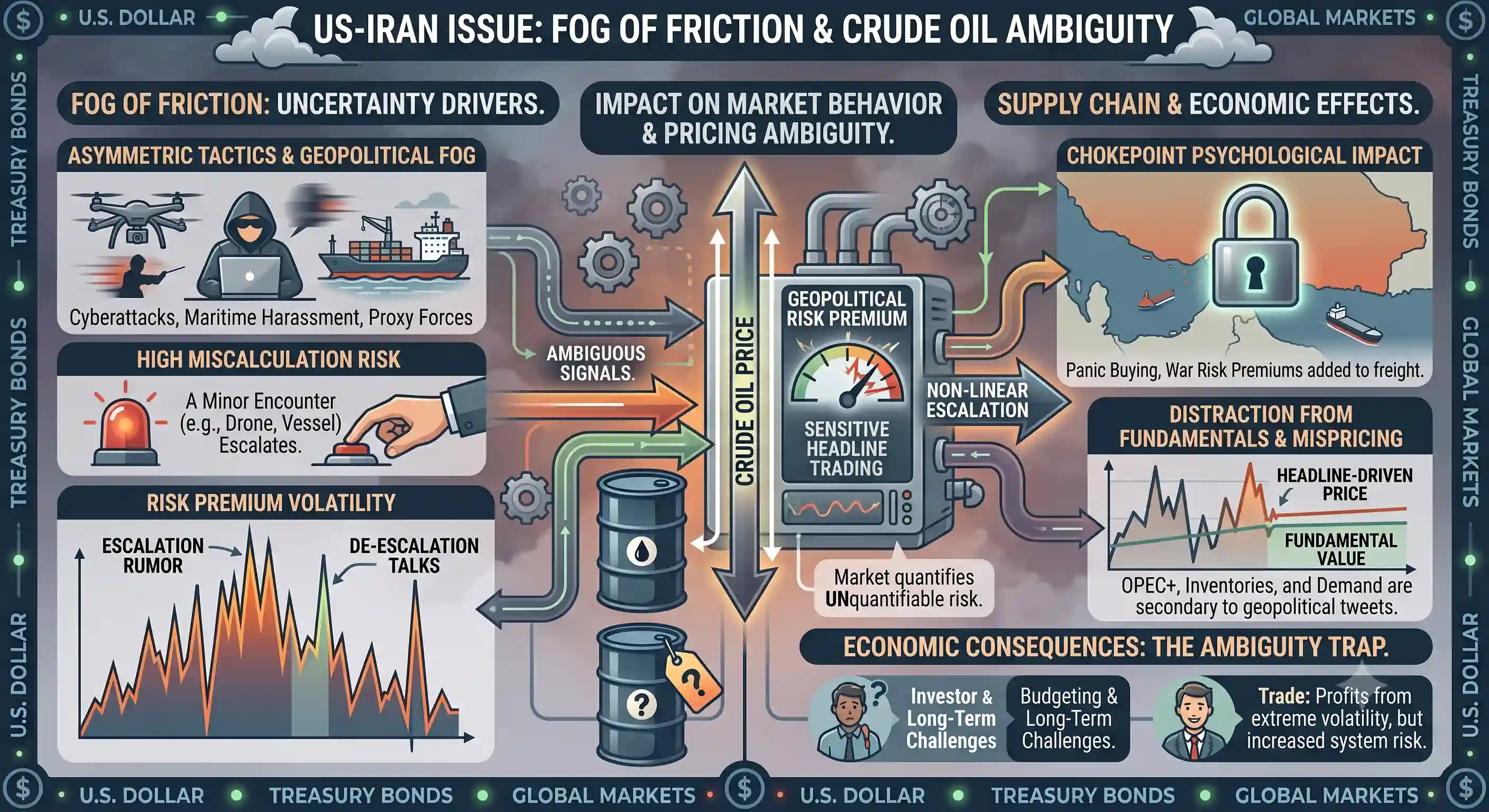
The global energy market finds itself caught in an uneasy state of limbo. Is the crisis between the United States and Iran heading toward a durable diplomatic resolution, or is it merely experiencing a brief pause before another sharp military escalation?
This pervasive ambiguity where peace deals are drafted only to face sudden breakdowns, and localized maritime strikes occur alongside low-level diplomatic channels has transformed the crude oil market into a hyper-sensitive arena. Rather than establishing a single, smooth directional trend, benchmark prices (Brent and WTI) are oscillating rapidly as trading desks continuously recalibrate the geopolitical "war premium" against physical supply fundamentals.
Current Market Dilemma: How Oil Prices Are Reacting to Ambiguity
When geopolitical conditions are crystal clear, energy markets adapt efficiently:
● Full-scale war with active blockades drives sustained upward rallies.
● Formal peace agreements trigger rapid sell-offs as risk premiums deflate.
1. Headline Whipsaws and Choppy Ranges
Instead of entering a structural bull or bear market, crude benchmarks are trading within wide, unpredictable ranges. News of an drafted memorandum or tentative ceasefire talks compresses the geopolitical risk premium by $5 to $10 per barrel in a matter of hours. Conversely, news of drone strikes, vessel detentions, or military deployments around crucial maritime chokepoints such as the Strait of Hormuz causes immediate, aggressive price spikes.
2. High Options Volatility and Hedging Costs
Energy traders and refiners are paying elevated premiums for options contracts to protect against sudden price moves in either direction. Implied volatility remains structurally elevated because no desk wants to be caught short during a sudden military escalation, nor caught long if a comprehensive peace deal is announced overnight.
3. Physical Fundamentals Act as the Anchor
While geopolitical headlines trigger short-term swings, physical supply metrics prevent prices from spiraling out of control in either direction:
● The Price Ceiling: Record non-OPEC production—led by the United States producing near record highs ensures there is a physical buffer, preventing temporary spikes from staying above $100 indefinitely.
● The Price Floor: Tight commercial inventories and ongoing logistical friction keep global physical supplies constrained enough to prevent crude from crashing into deep bear-market territory.
Scenario 1: What to Expect If the Conflict Escalates or War Continues
If ongoing friction breaks out into renewed, open military hostilities or extended maritime blockades, the energy complex will rapidly re-price for a structural supply deficit.
● Immediate Price Surge: Benchmark Brent crude would likely break past recent resistance, surging rapidly toward the $95 to $110+ per barrel range depending on the severity and duration of the disruption.
● Focus on Chokepoints: The key risk remains the Strait of Hormuz, through which roughly one-fifth of global petroleum liquids pass daily. Any sustained threat to commercial tanker traffic forces underwriters to hike war-risk insurance rates, driving up shipping costs even if physical infrastructure remains undamaged.
● Macroeconomic Cascades: A prolonged rally in energy prices would reignite global inflation concerns, complicating central bank policy (such as the Federal Reserve's interest rate trajectory), raising transport costs, and dampening global consumer demand.
Scenario 2: What to Expect If a Comprehensive Peace Deal Is Reached
Conversely, if ongoing diplomatic discussions culminate in a binding, verifiable peace agreement or a lasting regional treaty, the crude oil market would undergo a swift recalibration.
● Deflation of the War Premium: The $10 to $15 speculative risk premium embedded in current pricing would evaporate almost overnight, pulling Brent crude down toward the $65 to $72 per barrel zone.
● Return of Shut-in Barrels: A formal resolution would ease sanctions and logistical hurdles, paving the way for additional regional crude exports to flow back into global supply chains.
● Pivot to Macro Demand: With geopolitical risks removed from the driver's seat, market focus would pivot entirely back to economic fundamentals—such as global manufacturing health, interest rate paths, and non-OPEC supply expansion—which currently point to a well-supplied or even oversupplied global market.
The ongoing ambiguity surrounding US-Iran relations has transformed crude oil into one of the most event-driven assets in global finance. Until the geopolitical landscape achieves definitive clarity—either through a sustained diplomatic breakthrough or a decisive shift in regional stability—energy markets will remain prone to sharp, headline-driven volatility, keeping macro allocators and trading desks on high alert.