Fed rate Hawkish hold and FOMC Summary
 Jul 30th, 2026
 5 mins


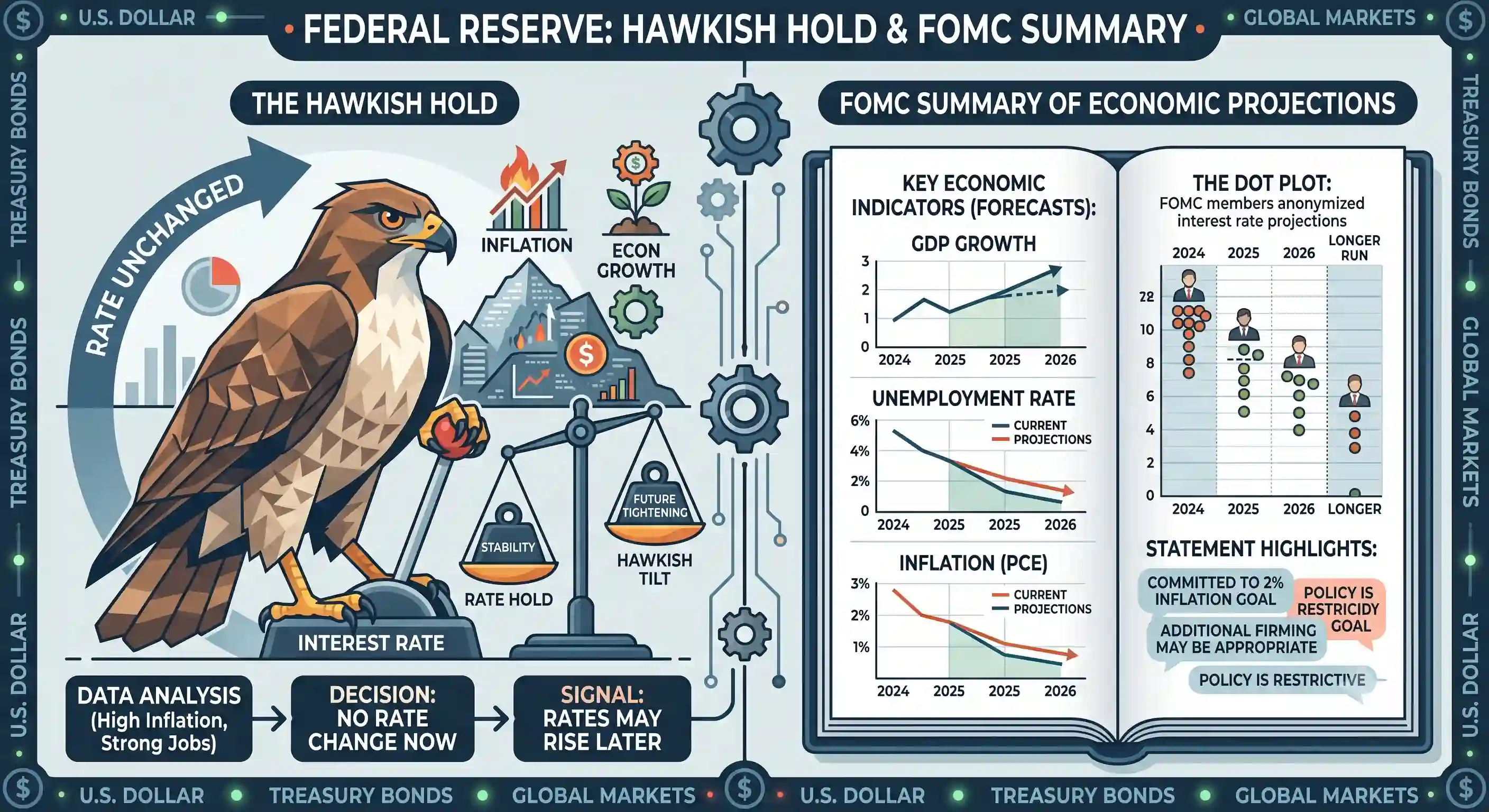
The Federal Open Market Committee (FOMC) concluded its two-day policy meeting on Wednesday, July 29, 2026, opting to keep the benchmark federal funds rate unchanged in the 3.50% to 3.75% range for the fifth consecutive meeting.
Led by Federal Reserve Chair Kevin Warsh, the central bank delivered what institutional markets are broadly describing as a "hawkish hold". While the decision to hold rates matched baseline consensus expectations, the underlying vote structure and statement tone signaled growing momentum toward a monetary tightening cycle as early as September.
Economic Relevance and the Preceding Macro Trend
To understand the context behind yesterday's policy outcome, it is essential to evaluate the conflicting economic forces shaping the U.S. macro environment throughout the summer of 2026:
● Stalled Progress on Inflation: While June's headline Consumer Price Index (CPI) moderated to 3.5% (down from 4.2% in May due to a temporary decline in gasoline prices), inflation has now remained above the Fed’s 2% objective for more than five years.
● The Middle East Energy Shock: Erupting military hostilities between the U.S. and Iran and ongoing maritime friction near the Strait of Hormuz have reignited severe supply-side inflation fears.
● Resilient Domestic Growth: Despite restrictive borrowing costs, broader U.S. economic activity continues to expand at a solid pace. Strong productivity gains, steady capital investment in AI data centers and energy infrastructure, and consistent labor market absorption have kept aggregate demand robust.
Key Takeaways from the FOMC Statement and Meeting
The July FOMC release delivered several critical policy signals that captured immediate attention on Wall Street:
1. Historic 3 Hawkish Dissent
The Committee approved the rate hold by a 9–3 vote. Cleveland Fed President Beth M. Hammack, Minneapolis Fed President Neel Kashkari, and Dallas Fed President Lorie K.
Logan all dissented, preferring an immediate 25-basis-point rate hike to 3.75%–4.00%.
This marks the first time since September 2016 that three FOMC members issued a unified dissent in favor of tighter monetary policy, underscoring intense internal pressure to curb persistent inflation risks.2. Statement Highlights
● Supply-Side Inflation Warning: The Fed explicitly noted that inflation remains elevated, in part reflecting supply shocks that have driven price increases in certain sectors, including energy.
● Uncertainty vs. Solid Output: The statement highlighted that economic activity is expanding at a solid pace despite elevated uncertainty because conflict in the Middle East.
● Minimal Verbiage Changes: Chair Kevin Warsh kept the core policy text virtually identical to June's release, maintaining a streamlined, concise message focused squarely on price stability.
How the Market and the U.S. Dollar Reacted
1. Short-Term Relief Selling: The U.S. Dollar Index experienced an initial dip of roughly 0.50% immediately following the release. Because some aggressive desks had positioned themselves for an outside chance of an immediate rate hike yesterday, the formal confirmation of a hold prompted brief profit-taking across long-dollar positions.
2. Medium Term Yield Support: Despite the minor pullback in the dollar index, U.S. Treasury yields rose sharply, with the 10-year yield climbing to 4.68%. The combination of three hawkish votes and persistent Middle East energy volatility led futures markets to price in an nearly 80% probability of a 25 bps rate hike at the September FOMC meeting.
3. Cross-Currency Dynamic: Against major low-yielding currencies like the Japanese Yen (USD/JPY), elevated U.S. yields continue to provide a firm structural floor, limiting downside dollar corrections even as risk assets pulled back.
The Federal Reserve's July 29 decision was far more than a simple status-quo pause. By keeping rates at 3.50%–3.75% while absorbing three unified votes for a rate hike, Chair Kevin Warsh and the FOMC delivered a clear message: unless geopolitical energy shocks subside and inflation metrics cool convincingly, the central bank stands ready to resume rate increases before the end of the year.