ADP Weekly unemployment change expectations and impact on dollar
 Jul 07th, 2026
 5 mins


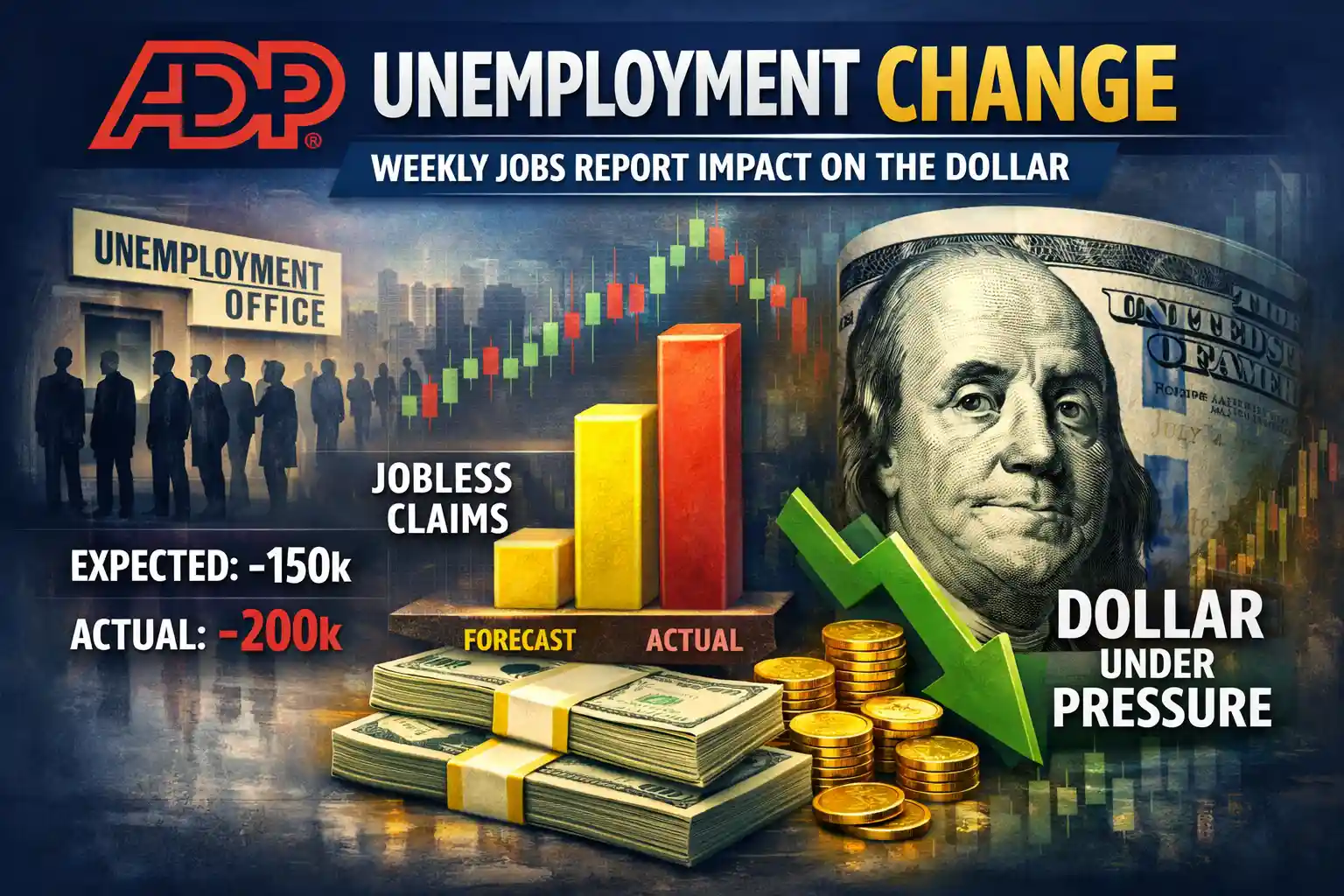
Release of the high-frequency ADP Weekly Employment Change data adds another layer of precision for global macro traders trying to read the direction of the United States economy. While the broader financial media remains fixated on lagging monthly aggregates, institutional currency and fixed-income desks utilize this fine-grained, real-time pulse to monitor the immediate trajectory of private-sector labor demand.
Coming directly on the heels of a highly volatile monthly data cycle, today's weekly print serves as a critical leading indicator of corporate hiring behavior. The data will heavily influence expectations for Federal Reserve policy and trigger direct adjustments across major U.S. Dollar pairs like USD/JPY and GBP/USD, as well as spot gold (XAU/USD).
Previous trend
To understand the baseline for today’s data, we have to look at the trend established over the previous month. High-frequency tracking has shown a gradual, calculated cooling in the private sector. The previous weekly indicator registered a net addition of 30.75K jobs. This marked a steady step down from the late-spring peaks when weekly hiring pulses regularly hovered above 40K. This multi-week deceleration perfectly explains the recent downshift observed in monthly non-farm payroll tracking. Corporate America has moved into a protective, "low-hire, low-fire" phase holding tight to current staff but remaining extremely conservative about expanding headcount amid restrictive borrowing costs.
What Are We Expecting Today and Why?
The market consensus expects today's high-frequency weekly print to consolidate near the 30K to 32K range, reflecting a continuation of this stable, lower-plateau expansion baseline.
Why a steady, lower-bound print is expected:
1. Normalization After Revisions: Following a string of sharp downward revisions to monthly jobs data, weekly hiring behavior has firmly normalized, filtering out the erratic post-pandemic catch-up spikes.
2. Seasonal Stabilization: Early summer hiring across mid-market services and transport has hit its mid-cycle baseline, reducing the likelihood of sudden, massive employment surges. The Forex Execution Plan: Scenario Analysis for the U.S. Dollar Because consumer aggregate demand is entirely dependent on labor market stability, any sudden shift in weekly private-sector hiring will directly alter how the foreign exchange market sizes up the Fed's next move. Scenario A: Resilient Surge (Prints above 45K)
● Macro Context: A sharp spike in weekly job creation indicates that corporate demand is re-accelerating despite high interest rates. This threatens to keep wage pressures firm, forcing fixed-income traders to push back any expectations of a dovish Federal Reserve policy shift.
● Dollar Impact: The Dollar strengthens sharply across the board. Scenario B: Neutral Consolidation (Prints between 28K and 33K)
● Macro Context: An in-line print confirms that the U.S. labor market is cooling down in an orderly, non-inflationary fashion. It supports the narrative of a balanced economy that is gently absorbing high interest rates without fracturing.
● Dollar Impact: The U.S. Dollar remains strictly range-bound. Because this matches current market pricing, initial fluctuations will quickly give way to mean-reversion, leaving traders to focus on upcoming trade balance and inflation data for the next structural catalyst. Scenario C: Contractionary Miss (Prints below 15K)
● Macro Context: A deep miss would signal that the corporate hiring engine has rapidly stalled out under the weight of sustained financial tightening. This outcome introduces immediate downside risks to consumer spending and shifts the macro focus completely toward economic preservation.
● Dollar Impact: The Dollar collapses as markets rapidly price in aggressive, front-loaded monetary easing from the Fed. Today's ADP weekly data provides a valuable, real-time look into corporate America's immediate economic confidence. For global macro participants, the degree of divergence from the 30.75K baseline will establish the immediate boundary lines for intraday risk management.