ADP Non Farm Employment Change expectations and impact on dollar
 Jul 01st, 2026
 5 mins


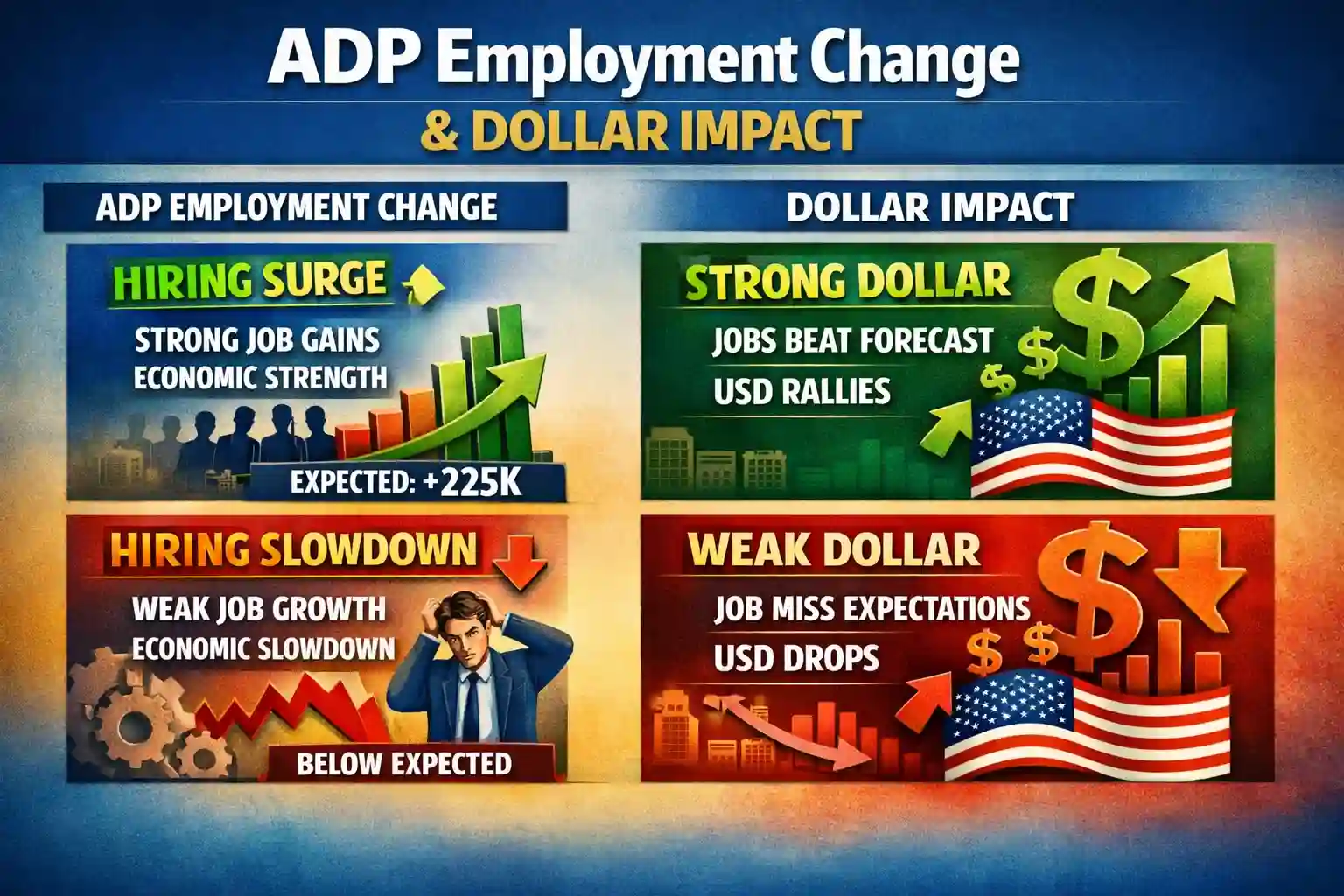
Today’s release of the ADP National Employment Report will trigger immediate, heavy order flow across global financial desks. Published by the Automated Data Processing Research Institute, this monthly measurement of private-sector payroll changes serves as the high frequency health check on corporate labor demand. Crucially, because it hits screens exactly a day ahead of the government’s official Bureau of Labor Statistics (BLS) non-farm payrolls data, currency and commodity markets treat the ADP print as a vital leading indicator for monetary policy. With the Federal Reserve carefully weighing signs of domestic economic moderation against sticky corporate input prices, today’s labor data provides the necessary foundation for determining the near-term strength of the U.S. Dollar.
Previous Trend
Baseline expectations for today's print, market participants must examine the macro momentum established late in the spring. In May, the ADP private payroll indicator registered a net expansion of 122,000 new positions, representing the highest single month of total private hiring momentum since January 2025. According to historical payroll tracking, the composition of that labor expansion revealed several structural shifts within the domestic economy:
● Small Business Resilience: Small-scale firms (fewer than 50 employees) led the pack by adding 67,000 of those total jobs, demonstrating a surprise pocket of consumer-facing business strength. ● Broad-Based Hiring Stabilization: Unlike the highly top-heavy hiring trends seen over the last two years, recent gains have expanded across broader service sectors, specifically food services, leisure, and regional healthcare infrastructure.
● The High-Frequency Cool-Down: Despite that firm monthly print, ADP’s high-frequency weekly tracking pulses throughout June showed a minor, progressive cooling trend. Private employers slowly ticked down their weekly hiring averages from a May peak of 40,750 per week to a consolidated average of roughly 30,750 per week heading into June's close. What is Expected Today and Why? The institutional Wall Street consensus forecast expects today's headline private payroll expansion to print at 118,000 for the month of June, a minor step down from May's 122,000 print.
Why?
1. "Low-Hire, Low-Fire" Strategy: While corporate layoff notifications have periodically ticked up in heavy administrative, financial, and tech verticals, broader industrial and mid-market firms are holding tightly onto existing labor. Rather than aggressively firing, they are restricting new hiring channels, creating a natural stabilization effect.
2. Normalizing Service Openings: Summer seasonal hiring within travel, transport, and hospitality has largely normalized after the massive, erratic post-pandemic swings, aligning closely with typical long-term baseline averages.
Impact on dollar
Scenario A: Strong Upside Beat (Prints above 140,000)
● Macro Context: An upside surprise completely disrupts the narrative of a cooling labor market. It signals that private domestic demand is running too warm for the Fed to comfortably lower interest rates, forcing fixed-income desks to price in a "high-for-longer" monetary regime.
● Dollar Impact: The dollar strengthens rapidly on an immediate wave of capital inflows.
Scenario B: In-Line Baseline (Prints between 110,000 and 125,000)
● Macro Context: This outcome validates current consensus models. It paints a picture of a controlled economic cooling one where the job market creates enough employment to prevent a consumer spending collapse, but slows down enough to keep the inflation engine from overheating.
● Dollar Impact: The U.S. Dollar remains highly range-bound within its recent consolidation zones. Scenario C: Severe Labor Miss (Prints below 95,000)
● Macro Context: A print below the psychologically vital 100k line would send shockwaves through the market, indicating that restrictive interest rates have finally severely impacted corporate hiring budgets. This increases the immediate threat of a wider economic slowdown.
● Dollar Impact: The Dollar collapses across the board as currency traders immediately price in aggressive, front-loaded interest rate cuts from the Federal Reserve to safeguard the labor market. For professional macro allocators and short-term traders alike, today's ADP release marks the start of the crucial early-month data gauntlet. By providing the first clear insight into corporate payroll trends, the margin of divergence from the 118,000 consensus estimate will establish the foundational risk parameters for the entire currency market heading into the new trading month.